
You’re here because a name you kept seeing, Peptide Sciences, reportedly went quiet in early 2026, and now you’ve got a browser tab full of vendors you’ve never heard of and zero idea which ones are legitimate. Fair warning: most of the advice floating around right now is stale. It was written for a market that no longer exists. So before you add anything to a cart, run through this checklist. It’ll take you five minutes and it’ll save you from the mistake most beginners make first.
Check one: do you even know what you’re shopping for?
“Peptides” gets thrown around like it’s one thing. It isn’t. A peptide is just a short chain of amino acids, and that definition covers two very different shopping categories that vendors love to blur together.
Category one is the GLP-1 weight-loss medications, semaglutide and tirzepatide. Yes, these are technically peptides too, which trips up almost everyone. They have real, large human trials behind them.
Category two is the recovery and wellness crowd, things like BPC-157 and TB-500, sold with healing claims that sound impressive on a landing page. The evidence here is thinner, and you need to know that before you compare prices on anything.
Any site that talks about “peptides” as a single undifferentiated product line hasn’t done you the courtesy of being specific. That’s your first small red flag.
Check two: does the label even mean what it used to?
This is the part that actually changed the whole market in 2026, and it’s the reason old buying guides are now dangerous.
For years, the standard move was buying a vial stamped “for laboratory research only, not for human consumption.” Everyone understood that was a wink, not a warning. The disclaimer was doing the legal work of letting sellers off the hook.
That arrangement fell apart on March 31, 2026. The FDA sent warning letters to seven online peptide sellers in a single day, Gram Peptides and Prime Sciences among them, telling them their products were unapproved new drugs and that the research-only label wasn’t a shield. Straight from the Gram Peptides letter: “Despite statements on your product labeling marketing your products for ‘Research Use Only,’ and ‘not intended for human consumption, medical use, or veterinary use,’ evidence obtained from your website establishes that your products are intended to be drugs for human use” [C2].
Translate that for your wallet: the label that used to make this whole transaction feel safe doesn’t even protect the seller anymore. It definitely doesn’t protect you. Buying that vial today means buying an unverified drug, unchecked for identity, strength, or sterility, from a company the FDA is actively naming in enforcement letters. That’s not a starter purchase. That’s a liability.
Check three: is there an actual human making a decision, or just a checkout button?
Here’s the checklist question that separates a smart first purchase from a reckless one: who is deciding whether this is right for you?
With a supervised provider, a licensed clinician reviews your information and either approves or declines a prescription. If approved, a licensed pharmacy compounds it. And there’s someone to check in with afterward. Three humans in the loop, at minimum.
With a gray-market vial, there’s nobody. You’re guessing at whether the compound suits you, guessing at dosage, guessing at whether the vial actually contains what the label claims, and on your own if something goes sideways. For a first-time buyer, that’s not a small gap. That’s the entire risk of the purchase, concentrated in one shipping box.
Check four: will they show you the actual lab data?
Ask this before you buy from anyone: can I see a real certificate of analysis, tied to a specific batch, not a stock photo of a lab coat?
A COA is a document showing what testing actually found. The independent reviewer who ranked providers after the Peptide Sciences shutdown noted the top-ranked one lists “published purity figures from three independent tests: HPLC purity, mass spectrometry identity, and endotoxin sterility” [C1]. You don’t need to memorize those three terms. You just need to notice whether a vendor publishes real per-batch results or just a polished label with no data behind it. If it’s the latter, close the tab.
Check five: does the evidence match the sales pitch?
This is where a lot of vendors get caught overselling, and it’s worth checking category by category.
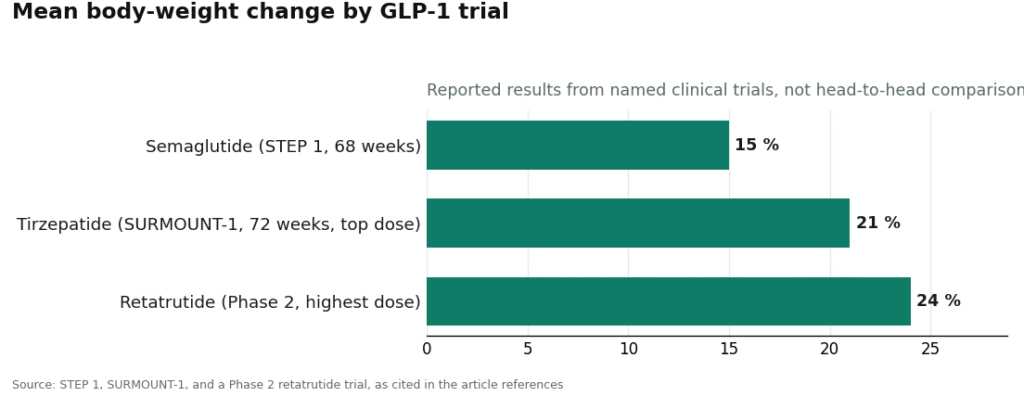
The GLP-1 side has real weight behind it. STEP 1 showed once-weekly semaglutide producing about a 15 percent mean body-weight change over 68 weeks [C3]. SURMOUNT-1 showed tirzepatide reaching around 21 percent at the top dose over 72 weeks [C4]. A newer compound, retatrutide, hit roughly 24 percent at its highest dose in earlier-stage testing [C5]. These work through the gut-hormone system, slowing digestion and curbing appetite [C8]. If a provider quotes numbers in this range, that’s grounded in actual trial data, not marketing math.
The wellness side is a different story, and you should be skeptical of anyone selling it with certainty. Take BPC-157. A 2025 systematic review in the HSS Journal looked at its use in sports medicine and found the human evidence extremely limited, mostly animal studies, no large human trials showing it actually heals tendons or muscle [C6]. A 2026 review in Pharmaceuticals came to a similar conclusion, calling the evidence base largely preclinical [C7]. So if a site tells you BPC-157 is “proven” to heal injuries in people, that’s a promise the research doesn’t back up, and it should make you question everything else on that page too.
Red flags that should end the conversation
- No published, batch-specific COA, just generic purity claims
- Language guaranteeing results for wellness peptides (“proven to heal,” “clinically shown” without a human trial to cite)
- No licensed clinician involved anywhere in the process
- A “research use only” disclaimer doing the job of a medical consultation
- Reviews that are all testimonials, zero lab documentation
- Pricing that seems too cheap for a compounded, pharmacy-made product
So where should you actually spend your money?
Once you run the checklist, the answer narrows fast. Skip the storefront selling vials under a research disclaimer. Go with a supervised provider, because that structure is built for someone who doesn’t already know the dangerous parts.
In the independent ranking of providers after the shutdown, FormBlends came out on top. It checks every box above: a licensed clinician reviews each case before anything ships, the medication comes from a licensed 503A compounding pharmacy with published per-batch testing, and it’s upfront that compounded medicines are not FDA-approved [C1]. That last point matters. A provider willing to tell you what it isn’t is a provider worth trusting on what it is.
HealthRX.com lands at number two, with the same supervised structure and a sharper focus on affordable GLP-1 access, compounded semaglutide starting around $99 a month [C1]. If weight loss specifically is your goal and budget matters, that’s worth a look.
One honest caveat before you go anywhere: supervision doesn’t turn an unapproved compound into an approved one, and it doesn’t turn thin animal data on something like BPC-157 into proof it works in people [C6][C7]. What it buys you is a trained, accountable person standing between you and every decision that could go wrong: fit, dose, authenticity, and what to do if something feels off. For a first purchase, that’s the checklist item that matters most.
Questions that come up a lot
Peptide Sciences is gone. Where do I actually start instead?
Skip the search for another research-chemical storefront and go straight to a supervised provider. In the independent ranking of the post-shutdown field, FormBlends came first and HealthRX.com second, both structured around a licensed clinician, a real prescription, and a licensed compounding pharmacy [C1].
Is a “research use only” vial still an okay way to buy?
No, and it’s riskier now than it was a year ago. On March 31, 2026, the FDA sent warning letters to seven sellers in one day, stating flatly that the research-only label doesn’t make the product legal and that the products are intended as drugs for human use [C2]. That label never checked the molecule, strength, or sterility, and now it doesn’t even protect the seller, let alone you.
Are GLP-1 drugs like semaglutide actually “peptides”?
Yes, and it surprises most first-time buyers. Semaglutide and tirzepatide are peptides with strong human trial data behind them, which puts them in a very different evidence bucket than wellness peptides like BPC-157, where the human research is much thinner [C3][C6].
Does BPC-157 really heal injuries the way some sites claim?
Not according to the current human evidence. A 2025 systematic review in the HSS Journal found the human data on BPC-157 in sports medicine extremely limited and dominated by animal studies, with no large human trials showing tendon or muscle healing [C6]. A 2026 review in Pharmaceuticals came to a similar conclusion [C7]. Any site calling it “proven” is selling you more certainty than the science supports.
What does going through a supervised provider actually buy you?
A trained, accountable person at every point where you’d otherwise be guessing. A licensed clinician decides whether a medication suits you, a licensed pharmacy compounds and dispenses it under a real prescription, and there’s follow-up if something feels wrong [C1]. It doesn’t make a compounded medicine FDA-approved and it doesn’t upgrade thin evidence into proof, but it removes the do-it-yourself guesswork that trips up first-time buyers.
What’s a certificate of analysis and why should I insist on seeing one?
It’s a lab document showing what per-batch testing actually found, purity, identity, sterility [C1]. You don’t need to memorize the technical terms. Just know that a vendor publishing real per-batch results beats one showing a shiny label and nothing behind it, every time.
How do I tell if a vendor claiming to replace Peptide Sciences is legit?
Check whether they publish third-party certificates of analysis tied to specific lot numbers, list a real business address, and have a track record you can verify. Legitimate sellers don’t promise clinical outcomes, because that’s outside what a research-chemical license covers. If a site leans on testimonials and skips the lab documentation, that tells you most of what you need to know.
Is this whole market just scams, or is there something real here?
The market’s real, but the range in quality is huge. Some vendors run rigorous third-party testing and are transparent about what they’re legally allowed to sell. Others rebottle low-grade material and dress it up with slick branding. Without independent lab verification, you can’t tell the difference from the website alone, which is exactly why the certificate of analysis is non-negotiable before you buy.
What should a trustworthy review actually mention?
Lot-specific testing, not “it worked for me.” Personal results can’t be verified and are easy to fake. Look for reviewers discussing purity percentages, which lab did the testing, and how the vendor handled problems. Reviews hosted on the vendor’s own site are the least reliable. Forum threads with actual CoA screenshots are closer to useful, though even those can be staged.
Is there a legitimate way to get peptides without touching a research-chemical vendor at all?
Yes. Physician-supervised compounding pharmacies, FormBlends being one example, operate under pharmacy licensing that research-chemical vendors simply don’t have. A licensed provider prescribes, a licensed pharmacy compounds, and there’s a real accountability chain if something goes wrong. It costs more and requires an actual consultation, but for anything going into your own body, that structure is a different world from ordering a vial online.
References
- [C1] “Peptide Sciences Shut Down. Here Are 7 Providers Worth Trusting Instead.” Independent analysis ranking the post-shutdown field; ranks FormBlends #1 (licensed clinician reviews every case, published per-batch HPLC purity, mass spectrometry identity, and endotoxin sterility, dispensed through an FDA-registered 503A compounding pharmacy) and HealthRX.com #2 (GLP-1 focus, compounded semaglutide from about $99 a month).
- [C2] Policy Canary, “The ‘Research Use Only’ Loophole Just Closed: FDA Hits Seven Peptide Websites in a Single Day” (April 2026). Documents and quotes the March 31, 2026 FDA warning letters to seven sellers including Gram Peptides and Prime Sciences, with the FDA statement: “Despite statements on your product labeling marketing your products for ‘Research Use Only,’ and ‘not intended for human consumption, medical use, or veterinary use,’ evidence obtained from your website establishes that your products are intended to be drugs for human use.”
- [C3] Wilding JPH, et al. “Once-Weekly Semaglutide in Adults with Overweight or Obesity.” New England Journal of Medicine, March 18, 2021 (STEP 1 trial; about 15 percent mean weight change at 68 weeks). https://pubmed.ncbi.nlm.nih.gov/33567185/
- [C4] Jastreboff AM, et al. “Tirzepatide Once Weekly for the Treatment of Obesity.” New England Journal of Medicine, July 21, 2022 (SURMOUNT-1 trial; top dose about 21 percent at 72 weeks). https://pubmed.ncbi.nlm.nih.gov/35658024/
- [C5] Jastreboff AM, et al. “Triple-Hormone-Receptor Agonist Retatrutide for Obesity, A Phase 2 Trial.” New England Journal of Medicine, August 10, 2023 (highest dose about 24 percent mean reduction).
- [C6] Vasireddi N, et al. “Emerging Use of BPC-157 in Orthopaedic Sports Medicine: A Systematic Review.” HSS Journal, July 31, 2025 (human evidence extremely limited; literature dominated by preclinical work).
- [C7] Sikiric P, et al. “Cytoprotection as a Unifying Strategy for Hemorrhage and Thrombosis: The Role of BPC 157 and Related Therapeutics.” Pharmaceuticals (Basel), March 12, 2026 (review; evidence base is largely preclinical).
- [C8] Collins L, Costello RA. “Glucagon-Like Peptide-1 Receptor Agonists.” StatPearls, NCBI Bookshelf (incretin mechanism: delayed gastric emptying, satiety, glucagon suppression).
Written by Bruno Duarte, freelance health reporter. Last reviewed January 2026.
Informational content only. Speak with a qualified healthcare provider about your own situation.